Same bits on every machine
A weighting filter designed by phonometry is the same filter, byte for byte, whatever C library, BLAS, LAPACK, thread count or hash seed it is designed under, whichever compiler built numpy, and on any processor: x86-64 with or without AVX-512 or fused multiply-adds, and 64-bit ARM. No library step is left on the design path. Every transcendental the fit takes is spelled in arithmetic IEEE 754 fixes or computed correctly rounded in exact integer arithmetic, so glibc, Apple’s libm, musl and the Windows runtime, and glibc’s x86-64 routines, built with fused multiply-adds or without, have no say in its bits. The two steps outside the fit that used to go through a numerical library are the package’s own arithmetic too: the poles of the BS.468-4 prototype, which LAPACK found, are the correctly rounded roots of the network’s exact polynomial, and the second-order sections, which SciPy formed through the BLAS, are SciPy’s own procedure with every product rounded once and every magnitude correctly rounded. This page records what was pinned and measures what it does. The coefficients a laptop designs are the coefficients a cluster designs, so a conformance verdict, a published figure or a filter shipped inside a measurement chain is a reproducible artifact rather than one machine’s account of itself.
That sentence is not how scientific Python normally behaves, and this page records what it cost, with the numbers.
Why floating point drifts between hosts
Section titled “Why floating point drifts between hosts”IEEE 754 pins every single operation: given two doubles, their sum, difference, product, quotient and square root are the same bit pattern on every conforming machine. Everything beyond a single operation is where reproducibility leaks, through three separate doors.
Reductions are free to reassociate. A sum of many terms has no defined order, and a BLAS picks the order that suits the vector registers it finds at run time. phonometry measured what that costs on its own weighting fit: two OpenBLAS kernel sets agreed on every accept decision of the Levenberg–Marquardt search for thirty-nine consecutive steps while the costs they were comparing drifted from 3 × 10⁻¹³ to 1 × 10⁻⁴ apart, and the two runs then landed on different filters: 5 × 10⁻⁵ apart in the leading coefficient, 0.002 dB apart in response, a visible 0.0225 pt apart in a plotted curve. An optimiser in a shallow valley amplifies whatever the last bit does.
Vectorised transcendentals are dispatched. numpy chooses log, exp,
tan, power, arctan and sin kernels by what the CPU offers, and the
AVX-512 kernels do not agree to the last bit with the ones a machine without
AVX-512 runs. Measured under Intel SDE emulating Skylake-X against the same
host natively: every one of those six returns a different digest over the
same inputs. The leak reaches further than the obvious call sites:
numpy.geomspace is 10 ** linspace(...), so the frequency grid every
residual of the fit is evaluated on came out different under AVX-512, and
every step downstream inherited it.
The platform’s own libm is a platform choice. math.log is whatever
log the C library ships. glibc’s and Apple’s are both accurate to about
half an ulp, which means that on a handful of inputs they legitimately round
to opposite neighbours, so a design loop built on math.log returned
different filters on macOS than on Linux with nothing anywhere to say so.
The same held for every other transcendental the C library ships, which is
why the A weighting at 48 kHz once hashed to three values on the three
platforms the CI matrix runs.
What phonometry pins
Section titled “What phonometry pins”The deterministic design path answers each door in kind, in
filters._weighting_design and the pinned modules it reads,
_internal.pinned_log, _internal.pinned_exp and _internal.pinned_trig:
- Its own reductions. Every sum the fit compares or solves with is folded
pairwise in a shape fixed by the code, and the normal equations are solved
by Gaussian elimination written out, the same algorithm LAPACK’s
dgesvruns with the order no longer a library’s choice. Pairwise folding is also the more accurate order: O(ε log n) rounding against the O(ε n) of a running total, so nothing was traded away. - Real arithmetic where complex arithmetic dispatches or fuses. Complex
multiply and complex magnitude fuse operations differently per CPU, and
numpy’s complex product and quotient are C loops a compiler may fuse into
multiply-adds: numpy built with clang, as on macOS and Windows, does, and
numpy built with GCC, as on Linux, does not. So every place the path
handed numpy or SciPy a complex expression is written out in real
arithmetic, numpy’s own steps in numpy’s order, each rounded once: the
printed curve the fit aims at, the read-back that sets the shipped gain,
and the bilinear transform with its gain, which SciPy’s
bilinear_zpkforms as a product of complex numbers. - Pinned transcendentals. Inside the iteration, the logarithm runs three
quarters of a million times per design, the exponential once per factor
per evaluation, and the power once per grid point in every Lawson round.
Each is glibc’s own routine spelled in numpy operations IEEE 754 fixes
exactly, plain arithmetic, integer bit work and table lookups: the
table-driven
logand thelog10built on it, and theexpandpowof ARM’s optimized-routines as glibc compiles them for a processor with a fused multiply-add, every multiply-add that build fuses reproduced by an exact emulation (rounding to odd, after Boldo and Melquiond). The sine, taken twice per design, the tangent, three times, the arctangent, once per design over the 257 points of the frequency grid, and the magnitude of a complex root are correctly rounded: the double nearest the exact value, found in exact integer arithmetic by Ziv’s loop. Their bits are their own on every machine, which is stronger than calling anyone’s libm, and no routine of the C library is left in the fit. For the arctangent that had a price on Linux: glibc’s own rounds 19 of the 15 866 arctangents the checked designs evaluate to the other neighbour, so the correctly rounded value moved six of the 133 checked designs by their last bits. glibc’s routine, which would have kept them where they were, is the IBM Accurate Mathematical Library, under LGPL-2.1-or-later, and is not transcribed into this MIT package. - The grid spelled out. The geometric frequency grid is generated term for term with the endpoints pinned, so the fit evaluates the same frequencies everywhere.
- No library step outside the fit. The BS.468-4 prototype’s six poles
were numpy’s polynomial roots: eigenvalues of the companion matrix, which
LAPACK finds by an iteration whose sums the BLAS and the compiler are free
to order and to fuse. The network’s denominator is now built from its
seven component values in exact rational arithmetic, and its roots are
found in exact arithmetic too and rounded once, each part to the double
nearest the exact root’s, decided by a certificate: a disk around each
approximation that provably holds one root and no other, and an extent in
each coordinate that lies strictly between the midpoints around one
double, or a coordinate shown in exact arithmetic to sit on one of those
midpoints, which rounds to even. The second-order sections were SciPy’s
zpk2sos, which forms each section’s polynomial withnumpy.convolve, whose complex products go to the BLAS, and pairs poles with zeros by numpy’s own complex magnitude, which is not correctly rounded. It is now spelled step for step and branch for branch, each product and sum rounded once and each magnitude correctly rounded; of two zeros at exactly the same distance from a pole it takes the first, as a stable sort does, where SciPy’s choice goes through numpy’s default sort, whose order of ties follows the processor.
The same path as one column, in the order the code runs it, each stage beside the library step it replaced:
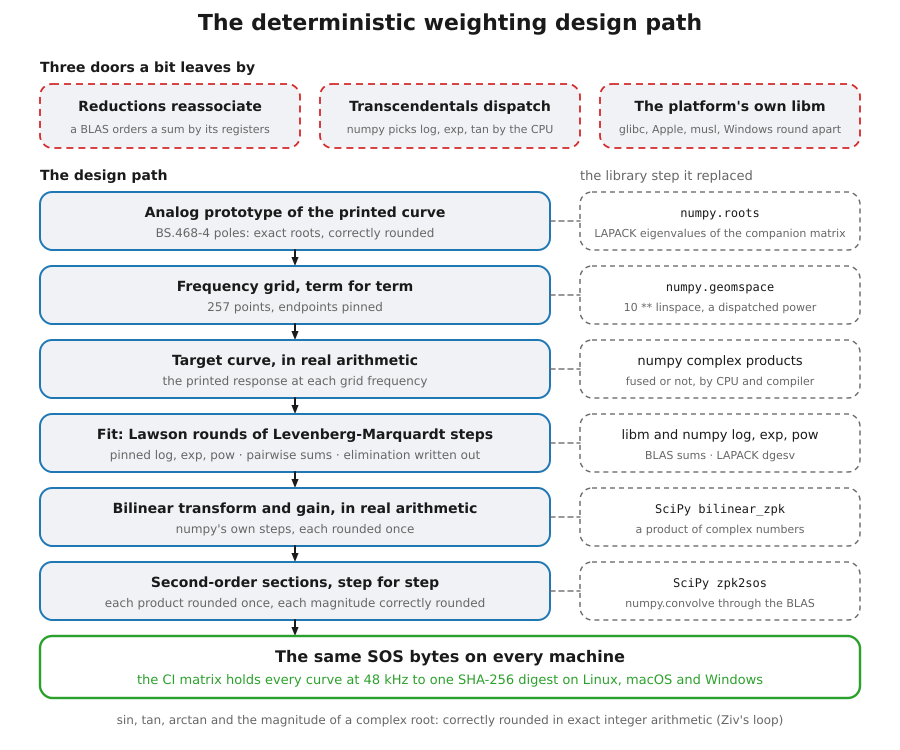
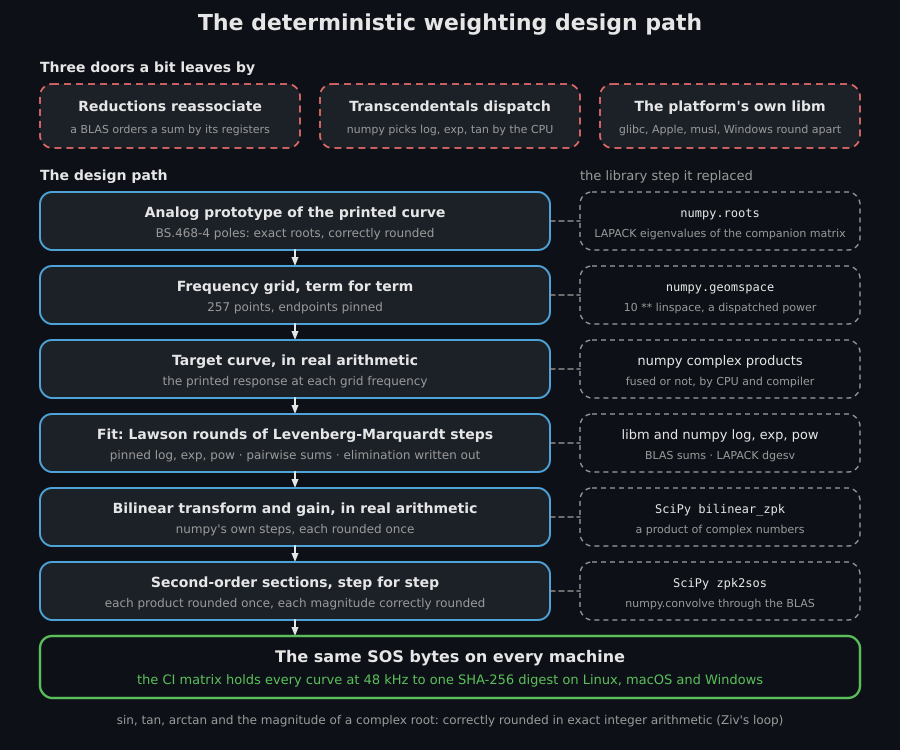
The order is the order of the code, not of the list above. The prototype comes first, because the fit starts from its poles, so the two steps the list names last sit on either side of the fit: the BS.468-4 poles before it and the second-order sections after it. The dashed boxes on the right are what each stage used to call, and the three doors close along the way: the grid and the pinned transcendentals close the second and the third, the pairwise sums and the elimination written out close the first, and real arithmetic takes the complex products away from the compiler that may or may not fuse them.
The evidence
Section titled “The evidence”Every claim above is measured, and most of them are re-measured by tests that run in CI:
- 91 658 333 inputs, zero exceptions. Every distinct value the whole
design corpus feeds its logarithm was captured and compared bit for bit
against glibc’s
log: identical on all of them, plus roughly a hundred million adversarial draws over the full exponent range, the near-one band, the subnormals and the branch edges. An adversarial search also found the honest limit: about one input in thirty million, in one narrow band, whose true logarithm sits within half an ulp of both neighbours and where the two implementations part by the last bit. None of those can reach a design, because on the design path the pinned routine is the definition. - The corpus moved where the arctangent did, and nowhere else. The designs of seven curves at nineteen sampling rates, 133 in all, hash to the same single SHA-256 before and after the logarithm was vectorised, and again after the exponential, the power, the base-10 logarithm, the sine, the tangent and the complex magnitudes were pinned. The correctly rounded arctangent then moved six of them by their last bits: the A and C weightings at 44.1 and 88.2 kHz, the D weighting at 88.2 kHz and the G weighting at 1.5 kHz. glibc’s 19 misrounded arctangents reach 32 of the 133 designs; in the other 26 the frequency that differs by one ulp gives the same target level to the last bit, so the fit never sees it. Put glibc’s arctangent back and the corpus hashes to its old SHA-256 again, and the six that moved stay inside the response bounds the tests hold.
- The last two library steps moved 21 designs on Linux, and no others. Spelling the poles and the sections moved all nineteen BS.468-4 designs, whose poles the correctly rounded roots place 2 to 36 units in the last place of each part away from LAPACK’s. The fit starts from the poles, and from a start a few units away it settles on other coefficients inside its tolerance: 7 to 13 of each design’s 18 move, by their last 9 to 12 bits at 250, 400 and 500 Hz and at 22.05 kHz by nearly half the value of one small coefficient, and the response differs by at most 0.0072 dB, at 125 Hz (0.0033 dB at 44.1 kHz, 0.000012 dB at 48 kHz). It moved the AU weighting by up to two units in the last place of eight coefficients at 100 Hz and by one unit of six at 200 Hz, where numpy’s complex magnitude, one unit off the correctly rounded one, had paired two zeros one unit in the last place apart the other way round. The other 112 checked designs keep their bytes, the A weighting at all nineteen rates among them, and every design that moved stays inside the response bounds the tests hold.
- The poles, against the exact value. The six poles are the roots an arbitrary-precision library finds, rounded part by part, and the test suite holds them to those doubles. Against the same library at 3000 bits, the root finder as it ships returned the correctly rounded value of every part of every root of 10 600 random polynomials, each in under half a second: 10 200 copies of the 468 network with each component moved by up to 30 %, 200 with integer coefficients of degree two to ten, four of them with a root at zero, and 200 whose roots spread over eighteen decades. numpy’s own answer differs from them by 4 to 21 units in the last place of the root’s magnitude, which is at most 3 % of the error LAPACK’s backward-stable eigensolver allows itself on that companion matrix, so the poles are what numpy finds, to numpy’s own error, and the same bytes everywhere. In CI the root finder is held to roots written in closed form and rounded by exact integer square roots, a method it does not use.
- The sections, against SciPy’s. Handed correctly rounded magnitudes,
SciPy’s
zpk2sosreturns the design’s sections bit for bit on the plain and the fitted prototype of every one of the 133 checked designs, on the build of numpy that rounds its complex products step by step; with numpy’s own magnitudes it parts from them only at AU at 100 and 200 Hz, as above, and the two realise the same response to 10⁻⁹ dB on every curve. With the BLAS’s complex dot product fused by emulation, SciPy’s sections for the D weighting at 48 kHz move by up to 11 units in the last place and the design’s do not move at all. - The exponential and the power, bit for bit. Every distinct value the
corpus hands
exp(677 596 of them) andpow(580 455) returns glibc’s bits, and so does each of 120 million draws over each routine’s domain, the edges of overflow and underflow and the subnormal results included. The fused multiply-add emulation returns the C library’sfmaon every one of 30 million draws, half of them nearly cancelling. - The arctangent, against the exact value. The pinned arctangent returns the correctly rounded double, computed independently by an arbitrary-precision library at 200 bits, on every one of the 15 866 distinct values the checked designs hand it, on 572 386 edge values (every power of two from the smallest subnormal to the largest double with 64 neighbours on each side, the signed zeros, the infinities, NaN, and the two bands where the answer stops being the argument or the double nearest π/2), on 60 million random bit patterns over the whole line of doubles, and on 150 million draws whose magnitude lies between 2⁻⁶² and 2⁶², where the routine does its real work. With its first pass cut to 56 bits, where a quarter to a third of the inputs need a second one and the error bound alone decides, 60 million more draws come back correctly rounded as well, and that bound, set against the exact value on a million evaluations at five working precisions, was never more than half used. In CI the answers are checked by exact rational bounds on the tangent, with no arctangent evaluated anywhere.
- Correctly rounded, where glibc is and where it is not. On the 70
sines, 105 tangents and 67 complex magnitudes the corpus evaluates, glibc
returns the correctly rounded value, so the correctly rounded routines
return its bits there; on 19 of its arctangents it does not, as above.
Away from the corpus the agreement rests on glibc’s accuracy rather than
on a proof: over every integer sampling rate from 100 Hz to
200 kHz, 5 864 of the 1 399 307 (rate, curve) designs
meet a sine or a tangent glibc rounds the other way, and 45 526 read
a target level glibc’s arctangent changes, and those designs can move on
Linux with the pins, by what one ulp grows into through the fit. Of the
common rates the checked set leaves out, 50 kHz for A, B, C and D and
100 kHz for AU meet a sine or a tangent (AU moves from
7ee0fe06b2a91373toec6c060d4b27d1b9), and 176.4 kHz for A, B and C the arctangent. - No C library left. With every result of twenty routines of the C
library pushed one unit in the last place, by a shim between Python and
the C library (the exponentials, the logarithms, the power, the
trigonometric and hyperbolic functions and their inverses, and
hypot), the whole corpus, fitted and plain, hashes to the same two SHA-256 values as without it, where on the code before the pinned arctangent each of twelve designs measured that way (the A weighting at 48, 44.1, 88.2 and 192 kHz, C at 44.1 and 88.2 kHz, D at 48 and 88.2 kHz, G at 1 and 1.5 kHz, and 468 and AU at 48 kHz) moved. musl, another C library, designs the whole corpus to glibc’s SHA-256 with nothing replaced, and so does glibc’s own build without FMA. On 64-bit ARM, the processor family of the macOS leg of the CI matrix, run in emulation under glibc and under musl with the OpenBLAS numpy ships there, all 133 designs are the x86-64 bytes; until the last two library steps were spelled, 33 of them parted there, the nineteen BS.468-4 designs at the poles and fourteen others at the sections. - Digest for digest across environments. The designs are bit-identical between this host and the same host under AVX-512 emulation, under every selectable OpenBLAS kernel set, every thread count and every hash seed; the environment-versus-environment comparisons are pinned as tests.
- One digest on three platforms. With only the logarithm pinned, the A
weighting at 48 kHz hashed to
991833ff389afe91on Linux (glibc, x86-64),4efa1818bd80e23aon macOS (arm64) and79852a57e60961c8on Windows (x86-64). With every transcendental pinned it still hashed to5f5e34e5d3a8aa6eon macOS and on Windows, one value for both: SciPy’s bilinear transform took the gain as a product of complex numbers, through the numpy loop clang fuses and GCC does not. A test that fuses those products and quotients on any platform reproduces that digest on the code that called SciPy, and on the transform written out in real arithmetic designs991833ff389afe91, the plain bilinear designs of every curve at 48 kHz unchanged with it. A test in the CI matrix designs the A weighting as it ships, nothing replaced, and holds it to991833ff389afe91on all three platforms, and the A weighting at 44.1 kHz todbea4b7fc4ad972b, and every other curve at 48 kHz to a digest of its own; a second test designs both again with an arctangent that owes nothing to the pinned routine, the C library’s answer walked to the correctly rounded double by exact rational bounds, and lands on the same digests. On glibc x86-64 without FMA the A weighting at 48 kHz hashed to43f786ffab5c4dd4before the pins, and the arctangent’s second build still parted nine of the 133 checked designs from the FMA build until it was pinned; the two builds now design the whole corpus to one SHA-256. The response tests that run on the same three platforms hold the A design within 0.013 dB of its analog prototype at 20 001 frequencies across its fit band, at each of the six rates they check; two platforms whose bytes still differed could differ by up to twice that, 0.026 dB, at one of those frequencies.
See it yourself
Section titled “See it yourself”Two designs are the same design, and the bytes have a name:
import hashlibfrom phonometry import filters
once = filters.WeightingFilter(48000, "A").sosagain = filters.WeightingFilter(48000, "A").sosprint(once.tobytes() == again.tobytes())                 # Truedigest = hashlib.sha256(once.tobytes()).hexdigest()print(digest[:16])                                       # 991833ff389afe91
The second line is the point: those sixteen hex digits, the head of the SHA-256, are not “what my machine got”, they are the digest of this release’s A weighting at 48 kHz on any machine, the one the CI matrix holds on Linux, macOS and Windows alike. If a future release moves a coefficient deliberately, the digest moves with it and the change is a documented event, never a property of your hardware.
The guarantee covers the deterministic weighting design path end to end, for every curve and every rate, on every platform: no step of it is a library’s, and the CI matrix holds every curve at 48 kHz to one digest on Linux, macOS and Windows. Block processing composes with it: a stateful cascade fed block by block is bit-identical to one pass over the whole record, so streaming does not spend the guarantee. General analysis functions built on numpy and SciPy in their ordinary form remain reproducible on one machine but may differ in the last bits across CPUs, which is the normal condition of scientific Python; the deterministic treatment is applied where a filter’s identity matters.
Nothing outside the fit is a library’s either. The BS.468-4 prototype’s poles and the second-order sections were the last two steps that were, the roots LAPACK found and the sections SciPy formed through the BLAS, and on 64-bit ARM under OpenBLAS they parted 33 of the 133 checked designs from the x86-64 bytes; both are now this package’s own arithmetic, measured to design every one of the 133 to the same bytes on x86-64 under glibc, with and without FMA, and under musl, and on 64-bit ARM under glibc and musl. Apple’s Accelerate, which the macOS build of numpy links, is no longer reached by the design, so the macOS bytes are claimed for every curve and held by the CI test.
The full engineering account lives with the code, in the module docstrings of
filters/_weighting_design.py,
_internal/pinned_log.py,
_internal/pinned_exp.py,
_internal/pinned_trig.py
and
_internal/pinned_roots.py,
and the tests that hold it are in
tests/filters/test_weighting_design.py
and the four tests/test_internal_pinned_*.py.
See also
Section titled “See also”- Conformance report: what the numbers are checked against; this page is why the checks read the same everywhere.
- Errata in published sources: the other half of the evidence story: where the printed expected value is the thing that is wrong.
- Frequency weightings: the guide to the curves the deterministic design realises.
- Block processing: the streaming identity the scope section leans on.